Recommended mobile CMIN2 VPS for 2026!
China Mobile CMIN2 VPS is currently one of the core solutions to resolve issues like evening peak lag and high latency for mainland China Mobile users accessing overseas servers. As one of the premium lines of the top three Chinese carriers, China Mobile CMIN2 relies on dedicated routing and priority forwarding mechanisms to maintain low and stable latency performance even during network congestion periods.

1. What Is the China Mobile CMIN2 Line?
What is the China Mobile CMIN2 line? Simply put, CMIN2 (China Mobile International 2.0) is a new generation of premium international routing launched by China Mobile International, mainly serving scenarios where mainland China Mobile users access overseas servers. Compared with traditional CMI (China Mobile Internet) standard lines, CMIN2 features specialized routing optimizations at the backbone network level, prioritizing latency and packet loss performance for mainland Chinese users when accessing overseas nodes. Particularly during the traditional network congestion peak from 8:00 PM to 12:00 AM, CMIN2 can still maintain relatively stable transmission quality without common issues found on standard lines, such as packet loss, jitter, and lag.
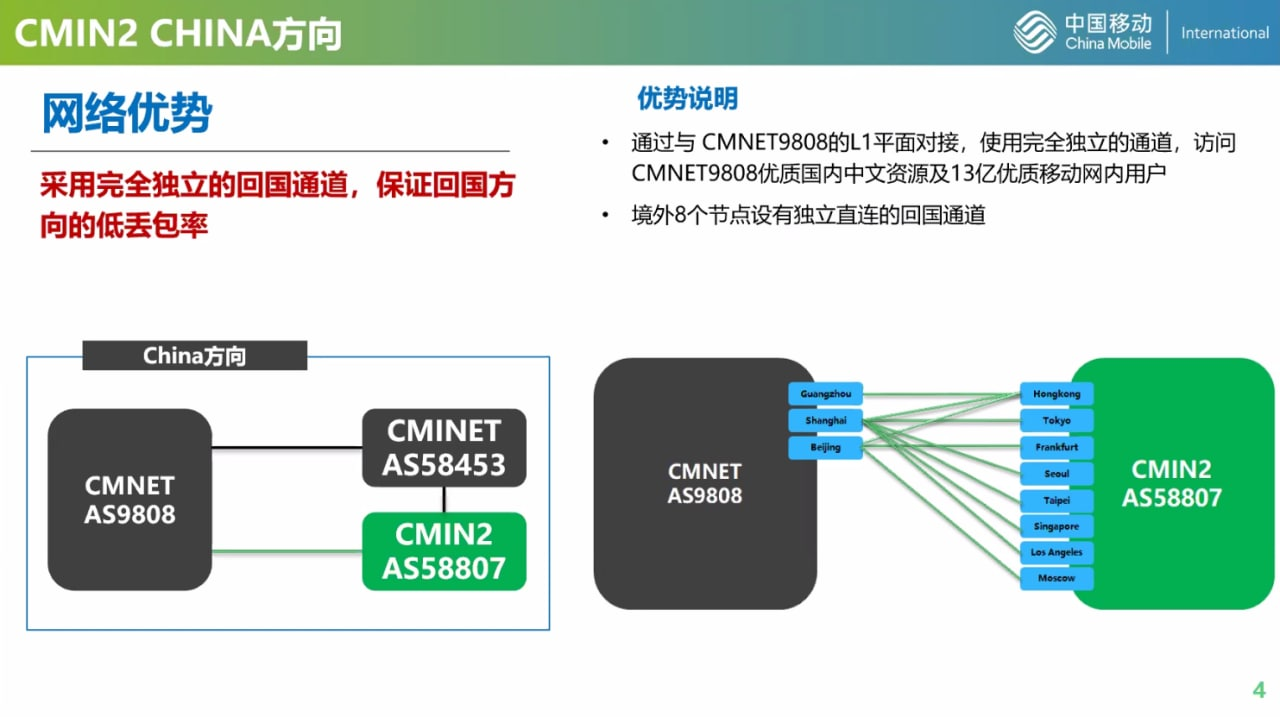
It should be noted that CMIN2 is currently not a line resource accessible by all overseas data centers. It imposes high requirements on data center network interconnection capabilities and BGP routing policies, making genuinely stable CMIN2 resources relatively scarce on the market. For businesses that require long-term stable service for mainland China Mobile user groups—such as remote work, live online education, and game acceleration relay—choosing a VPS with a CMIN2 line can significantly reduce user churn caused by poor network quality.
CMIN2 adopts an independent high-quality routing identifier similar to CN2 GIA, enjoying higher forwarding priority in the backbone network. As a result, it reduces detours and queuing delays in cross-carrier interconnections. In actual speed tests, round-trip latency can usually be controlled within a low and minimally fluctuating range, which is especially critical for real-time demanding scenarios such as voice calls and remote operations.
Furthermore, from the perspective of user scale, China Mobile is the carrier with the largest user base in China, accounting for an even higher proportion in third- and fourth-tier cities as well as mobile network user groups. Therefore, the value of the CMIN2 line is reflected not only in technical metrics, but also in its coverage breadth. For applications targeting the general public—such as mainland acceleration nodes for overseas apps and educational streaming platforms—lacking CMIN2 support could easily result in a significant portion of Mobile users experiencing obvious lag during evening peak hours, thereby harming overall retention and conversion rates. This is why more and more users treat CMIN2 as a mandatory criterion when purchasing a VPS.
2. Premium Lines of the Big Three Carriers
In addition to China Mobile CMIN2, the complete premium line system of the big three carriers also includes China Telecom's CN2 GIA and China Unicom's AS9929. These three lines represent the highest-level routing at the international outbound level for China Telecom, China Unicom, and China Mobile, respectively. Their common feature is the use of dedicated BGP AS number blocks, offering distinct advantages in packet loss rate, latency stability, and congestion resistance compared to standard optimized or BGP lines like 163 (Telecom), 4837 (Unicom), and CMI (Mobile).
Each of the three premium lines has its own focus: CN2 GIA is renowned for its ultra-low latency and stability, recognized as a top-tier international route; AS9929 excels in access quality for Unicom users; and CMIN2 addresses the long-standing shortcoming of weaker international access experience for Mobile users. If a VPS can simultaneously feature premium lines from Telecom, Unicom, and Mobile, it can theoretically cover the high-quality access demands of the vast majority of domestic carrier users. This is why many cross-border businesses prefer to look for "Triple-Carrier Premium" rather than single-carrier premium lines when selecting servers.
It is worth noting that premium lines generally cost more than standard optimized lines or BGP lines, as data centers must pay higher international bandwidth settlement fees for them. Consequently, few providers on the market can consistently supply stable Triple-Carrier Premium lines over the long term. When purchasing, it is advisable to combine actual speed test results and reputation reviews for a comprehensive assessment, rather than relying solely on advertised specs.
3. VMRack Premium Lines
At the practical product level, VMRack Premium Lines represent one of the few solutions currently on the market that simultaneously integrate CN2 GIA, AS9929, and CMIN2 Triple-Carrier Premium routes. Relying on its self-built Los Angeles data center, VMRack maintains full autonomous control over international outbound routing, enabling targeted BGP policy optimization for Triple-Carrier Premium lines rather than simply relying on third-party transit providers—a crucial guarantee for its stability during evening peak hours.
VMRack's Triple-Carrier Premium VPS (L3) is primarily designed for users with stringent requirements for mainland access quality, such as latency-sensitive operations like remote desktop work, real-time live streaming, and cross-border e-commerce backends. Beyond Triple-Carrier Premium lines, VMRack also offers Triple-Carrier Optimized VPS (L2) featuring a combination of 163 + 10099 + CMI, as well as International BGP products (L1) utilizing US native lines like Cogent and Arelion, allowing flexible choices based on different tradeoffs between latency and cost. Additionally, VMRack's self-built data center comes equipped with over 200Gbps of free DDoS protection, multiple IPv4/IPv6 and intranet IP resources, and supports various payment methods including Alipay, PayPal, Stripe, and USDT for user convenience across different regions.
Summary
In summary, for cross-border businesses targeting mainland China Mobile users, China Mobile CMIN2 VPS can effectively solve latency fluctuations and packet loss issues prone to occur on standard international lines during evening peak hours, making it a key factor in enhancing user access experience. When purchasing, it is recommended to prioritize providers that possess Triple-Carrier Premium capabilities and resource control over self-built data centers, thereby securing a more stable and sustainable network quality guarantee over long-term use.


- Products
- VPS Hosting
- VPS HostingUnmetered
- Bare Metal
- GPU Rental
- CDNPublic Beta
- Custom CDN
- Object StoragePublic Beta
- TranscoderPublic Beta