Which is better, CMIN2 or CN2 GIA?
Which is better, CMIN2 or CN2 GIA? There is actually no absolute standard answer to this question. CN2 GIA is China Telecom's flagship premium international outbound route, while CMIN2 is an internationally optimized route custom-built by China Mobile. Originating from different ISP systems, they differ significantly in underlying technical paths, coverage areas, and performance during peak evening hours. Below, we will analyze these two routes in detail from three aspects—technical principles, practical performance, and combined usage—to help you gain a more comprehensive understanding of their respective characteristics.

Analysis of Technical Principles and Advantages of Telecom CN2 GIA Line
Telecom CN2 GIA line (China Telecom Next Generation Carrying Network Global Internet Access) is a high-end international outbound channel launched by China Telecom on top of its traditional CN2 network. Compared to standard CN2, CN2 GIA features independent routing isolation at the backbone network level; its international outbound traffic is not mixed with standard international bandwidth, nor is it as vulnerable to cross-border bandwidth congestion as conventional lines. Because of this dedicated networking architecture, Telecom CN2 GIA can consistently maintain low packet loss rates and relatively stable latency performance during peak evening hours (typically 8:00 PM to 11:00 PM) when trans-Pacific links are most prone to congestion. This is the core reason why it has long been regarded as a "premium line."
For China Telecom users, accessing US servers equipped with CN2 GIA generally keeps round-trip latency within a highly ideal range. This is especially true for users in southern coastal cities, where the routing path to US West data centers is inherently advantageous; combining this with CN2 GIA's dedicated routing results in an even smoother overall experience. This is why many latency-sensitive services—such as remote desktop connections, financial trading systems, video conferencing, and certain low-latency streaming scenarios—prioritize servers connected to CN2 GIA lines. If latency jitter or packet loss occurs in these workloads, it can easily lead to lag or disconnections, and CN2 GIA delivers reliable protection precisely in this regard.
Analysis of Technical Principles and Advantages of Mobile CMIN2 Line
Mobile CMIN2 line is an optimized channel specially built by China Mobile to address international interconnection issues. Before CMIN2 was officially launched, China Mobile users accessing overseas servers often had to route through multiple transit nodes. These circuitous paths resulted in high latency and relatively unstable packet loss rates, which was a clear shortcoming in cross-border access for Mobile users and a long-standing pain point. Since CMIN2 was introduced, the routing path for Mobile users accessing overseas servers (such as those in the US) has been drastically simplified, reducing unnecessary transit hops and significantly improving evening peak-hour latency and packet loss compared to before.
In terms of practical performance, Mobile CMIN2 offers particularly noticeable enhancements for business scenarios with a high proportion of China Mobile users—such as applications targeting lower-tier markets, mobile game acceleration, live streaming co-hosting, and voice-based social apps. Users of these services are often distributed in areas with widespread China Mobile network coverage. Choosing servers with CMIN2 integration provides a noticeably smoother and more stable connection compared to standard international bandwidth. At the same time, given China Mobile's massive user base, the value of the CMIN2 line continues to be recognized by an increasing number of businesses.
Of course, objectively speaking, CMIN2 still trails behind CN2 GIA in terms of deployment scale and node coverage, making its geographic and scenario coverage somewhat less mature. If a business has a customer base with significant proportions of China Telecom and China Unicom users, relying solely on CMIN2 may result in performance bottlenecks for those users, failing to provide a well-rounded solution for everyone.
How to Choose: Tri-Net Premium is the More Reliable Solution
Whether Mobile CMIN2 or Telecom CN2 GIA is better ultimately depends on your user profile and business characteristics. However, in reality, most services serving nationwide users rarely draw from a single ISP source, making it difficult for any single route to satisfy the access experience of users across all operators. This is why an increasing number of users are turning to integrated tri-net solutions.
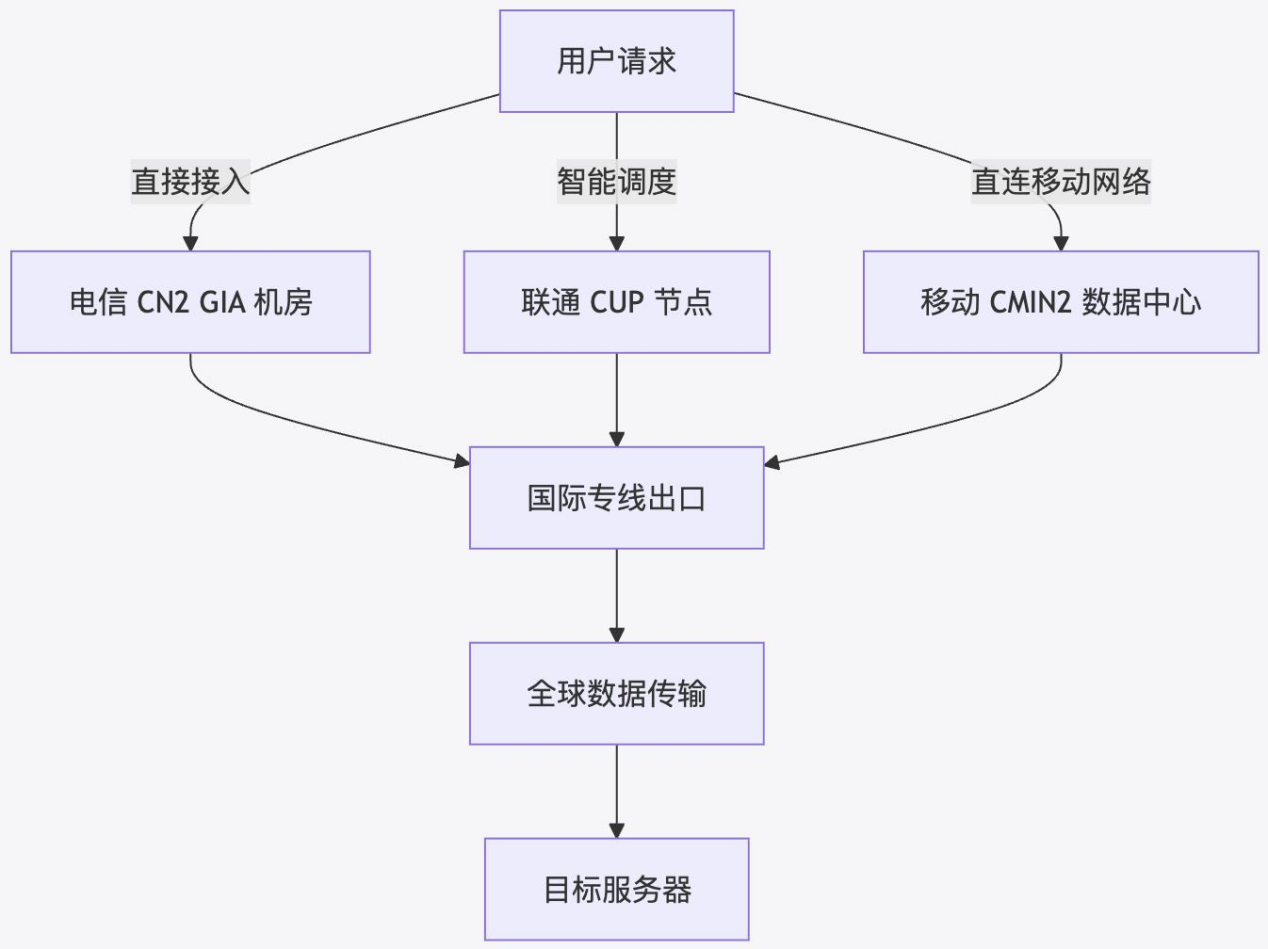
Taking the VMRack Tri-Net Premium line as an example, this solution integrates three top-tier routes simultaneously: CN2 GIA, AS9929, and CMIN2. This is equivalent to consolidating the finest network resources of all three major carriers onto a single server. The server automatically routes traffic through the optimal transmission path based on the visiting user's carrier network, ensuring that users on Telecom, Mobile, or Unicom all enjoy a balanced and high-quality access experience. Leveraging its self-hosted data center in Los Angeles, VMRack maintains full control over its network resources, allowing for fine-tuned routing optimization and bandwidth allocation specifically tailored for the VMRack Tri-Net Premium line.
For ultra-latency-sensitive business scenarios like remote desktop and online multi-user collaboration, relying solely on a single carrier line can easily result in performance fluctuations during specific time windows or in particular regions. By combining multiple top-tier route resources, tri-net premium lines effectively mitigate the risks associated with single-carrier limitations, allowing users across diverse network environments to enjoy consistent access quality. Furthermore, VMRack data centers provide over 200 Gbps of free DDoS protection. Paired with tri-net premium routes, this ensures business continuity and stability even when facing sudden traffic surges or malicious attacks.
Summary
There is no standard answer to whether CMIN2 or CN2 GIA is better. Both lines optimize international access paths specifically for China Mobile and China Telecom users, respectively, and each offers distinct advantages across different user demographics and business scenarios. However, if you need to accommodate users across multiple carriers simultaneously, integrating premium routes from China Telecom, China Mobile, and China Unicom into a single solution provides a far more reliable and worry-free approach.
- CN2 GIA vs. AS9929 vs. CMIN2: Which is the Stablest Outbound Route in 2026?
- Guide to Selecting US VPS Servers: The Advantages of Los Angeles Data Centers
- How to Quickly Detect CN2 GIA Lines?
- GIA Line vs. GT Line: Why GIA is the Top Choice for Stable Return Trips to China
- VMRack premium VPS test across three networks

- Products
- VPS Hosting
- VPS HostingUnmetered
- Bare Metal
- GPU Rental
- CDNPublic Beta
- Custom CDN
- Object StoragePublic Beta
- TranscoderPublic Beta