GIA Line vs. GT Line: Why GIA is the Top Choice for Stable Return Trips to China
The Underlying Logic of GIA vs. GT Routes
GIA (Global Internet Access) is the premium-tier product within China Telecom’s CN2 network family. Architecturally, GIA utilizes independent links for both outbound and return traffic. Its defining characteristic is that it travels entirely through the CN2 (AS4809) backbone network. Because it carries the highest bandwidth priority, GIA traffic is given preferential treatment even when gateway capacity reaches its limit, resulting in exceptionally low packet loss and peak stability.

In contrast, the GT (Global Transit) route is considered a mid-tier alternative. While GT may connect to CN2 nodes in overseas segments, it merges with the standard civilian network (163 Backbone / AS4134) when passing through China's international gateways. Consequently, during "evening peak" hours—when civilian traffic surges—GT traffic faces severe queuing and congestion at the exit point.
Return Routing: Why GIA Holds the Overwhelming Advantage?
For VPS users, while the outbound route (data sent to the server) is important, the return route (data returning to the user) is what truly dictates loading speeds. CN2 GIA pushes return routing to the extreme: regardless of whether you are a China Telecom, Unicom, or Mobile user, premium GIA providers typically force data to return to China via the CN2 backbone. This "return optimization" effectively bypasses the complex and congested exchange nodes between different provinces.
Many budget hosting providers market GT routes as a selling point, but users often find the experience underwhelming. This is because GT routes frequently switch back to the standard 163 line for the return trip, leading to a "smooth going, laggy coming" phenomenon. For industries relying on real-time interaction—such as e-commerce, gaming, and finance—this return-path instability is fatal, causing violent latency jitter.
To address this pain point, VMRack has implemented deep link optimization within our self-built Los Angeles data center. We don't just offer premium return routes for all three major carriers; we feature a top-tier CN2 GIA + AS9929 + CMIN2 architecture. This ensures that Telecom, Unicom, and Mobile users all enjoy a "dedicated line" speed when accessing China, solving the physical-level interconnection challenges between different ISPs.
How to Identify Real vs. Fake GIA Routes?
In the current market, many providers exploit technical jargon to disguise GT routes as GIA. The most direct way to verify authenticity is through Route Tracing (MTR or Traceroute) tools. A genuine GIA route will display IP addresses starting with 59.43.x.x throughout the hops entering China, persisting until the target city, rather than appearing only in the overseas segments.
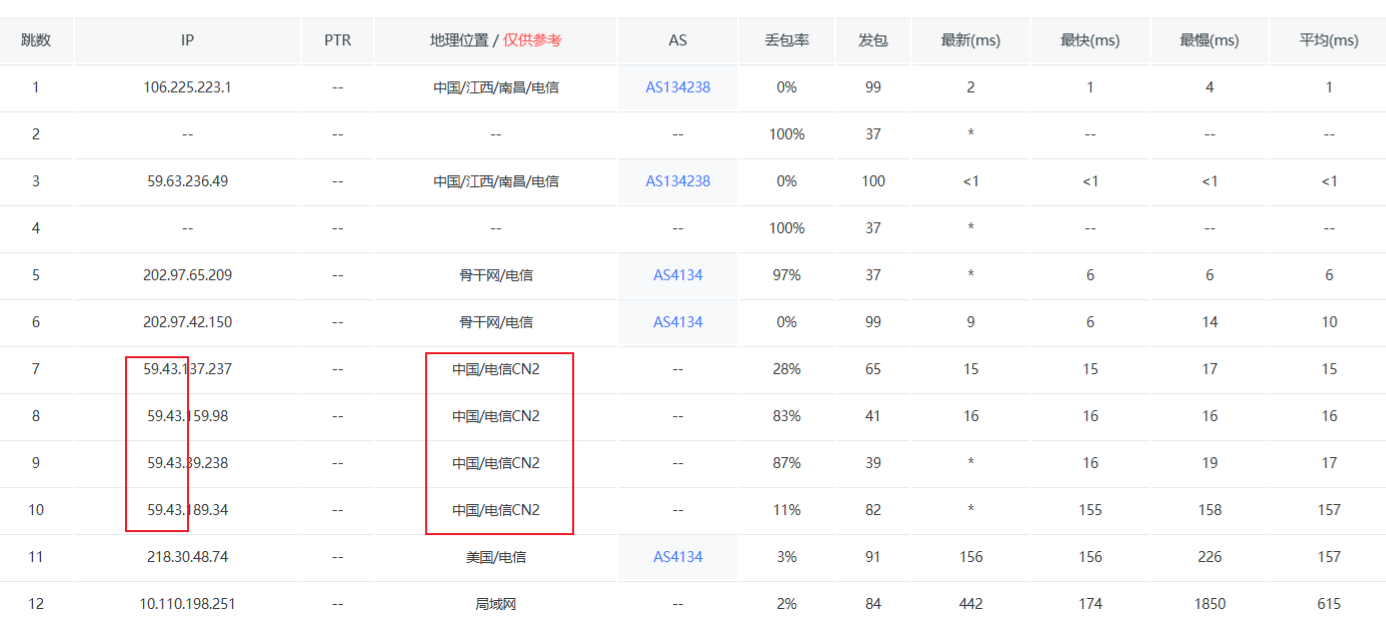
Furthermore, beware of the "One-Way GIA" trap. Some products use CN2 for the outbound trip but revert to the 163 line for the return trip to cut costs. While this setup performs okay during off-peak hours, packet loss often spikes above 10% during the evening peak (20:00 to 23:00). VMRack insists on bidirectional fully-optimized links to ensure high availability at any time of day.
Beyond IP addresses, bandwidth priority allocation is a hidden indicator. Because the procurement cost of high-quality GIA lines is significant, reputable providers rarely maintain profits through overselling. If a VPS offers massive bandwidth at an impossibly low price, it is likely sharing a congested GT line or mixing a small amount of CN2 traffic into a standard 163 route.
Summary
In short, choosing a GIA route is not just about choosing speed—it is about choosing business certainty. In today’s hyper-competitive global market, a one-second delay in page loading can mean the loss of a potential customer. While the cost is slightly higher than standard routes, the return on investment in terms of reduced packet loss, lower latency, and enhanced user experience is massive.
VMRack is committed to building the most stable network foundation for our users. Our Los Angeles VPS series effectively cures the "stuttering" of cross-border access by deploying the finest transmission links available. If you are looking for an overseas server capable of supporting high-frequency business demands, choosing the right route is your first step toward success.
- CN2 GIA vs. AS9929 vs. CMIN2: Which is the Stablest Outbound Route in 2026?
- How to Quickly Detect CN2 GIA Lines?
- Why CN2 Line VPS is the Foundation for Stable Remote Desktop Connections?
- Cost-Effective US Cloud Server Recommendation: Unveiling VMRack Los Angeles Node Performance
- How is the latency of the US CN2 GIA server?


- Products
- VPS Hosting
- VPS HostingUnmetered
- Bare Metal
- GPU Rental
- CDNPublic Beta
- Custom CDN
- Object StoragePublic Beta
- TranscoderPublic Beta