How is the latency of the US CN2 GIA server?
For cross-border e-commerce, foreign trade enterprises, and outbound gaming teams pursuing the ultimate network experience, server latency and stability directly determine user retention rates. Among numerous US data center lines, "CN2 GIA" has almost become synonymous with low latency and high stability. So, how is the actual latency of a US CN2 GIA server? Can it still maintain smoothness during the most headache-inducing evening peak hours every day? This article will combine the actual performance of VMRack's self-built Los Angeles data center to uncover the true network capabilities of premium US routes.
What is the Latency of a UPS?
Many users new to overseas servers often ask: What is the latency from a US CN2 server to Mainland China? From a geographical perspective, the US and China span across the Pacific Ocean, and there is a physical limit to the transmission of optical signals in fiber-optic cables. On regular lines (such as the 163 backbone network), due to routing node congestion, latency is usually above 250ms, and it can even soar to 400ms along with severe packet loss during evening peak hours.

On the other hand, servers utilizing US CN2 GIA lines have their telecom return traffic connected directly to the highest tier of service (GIA) within China Telecom's Next-Generation Carrier Network (CN2 Core Network). Under normal circumstances, the physical latency of a direct connection from a US West Coast (such as Los Angeles) data center to coastal cities in Mainland China can be stabilized between 130ms - 160ms, and around 160ms - 190ms for inland regions. More importantly, CN2 GIA possesses independent return bandwidth channels. This means that even during the massive network traffic jams from 8:00 PM to 11:00 PM, it can maintain an extremely low packet loss rate, ensuring that remote desktops and webpage loading experience zero stuttering.
VMRack Premium Three-Network Latency Testing and Performance
As a self-developed cloud infrastructure service provider under EasyLink, VMRack relies on its self-built Los Angeles data center to launch flagship CN2 GIA VPS products tailored for the Mainland China market. To completely resolve the speed differences that a single line faces across different carriers, VMRack has exclusively crafted a "Premium Three-Network" network architecture. This architecture not only includes the traditional top-tier China Telecom CN2 GIA line, but also integrates China Unicom's AS9929 premium China Unicom A-network line, as well as China Mobile's latest CMIN2 premium cross-border large-bandwidth line.
1. Fully Direct-Connected Three-Network, Saying Goodbye to Evening Peak Congestion
Traditional VPS providers are often only friendly to Telecom users, while Unicom and Mobile users may experience detour routing when accessing them. By deploying the VMRack Premium Three-Network, VMRack ensures that all three major carriers utilize their respective top-tier premium channels for return traffic in the Los Angeles data center. This means that whether Telecom, Unicom, or Mobile users access your website, they can enjoy the same specification of low latency and high stability.
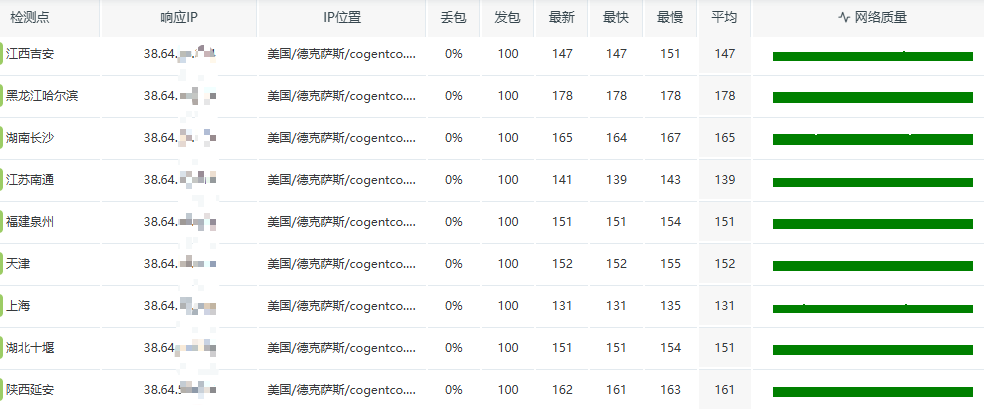
In actual testing, the evening peak packet loss rate of this line is typically controlled below 1%, completely solving the pain points of latency-sensitive businesses such as cross-border live streaming and real-time audio/video interaction. To prove this, the VMRack technical team conducted latency and packet loss tests on CN2 GIA VPS deployed on the VMRack platform during the evening peak hours of 20:00 - 23:00 (the most congested period for network-wide traffic).
2. High-Performance Hardware and Comprehensive Security Guarantees
In addition to impeccable network latency, an excellent CN2 GIA VPS requires powerful computing power support. The VMRack cloud server platform is built entirely on high-performance AMD processors, deeply optimized specifically for cloud virtualization environments. Whether running high-concurrency web applications or processing complex database computing tasks, it can provide a smooth experience comparable to dedicated servers.
Furthermore, VMRack's self-built Los Angeles data center complies with strict international environmental and energy management standards. The facility is equipped with UPS uninterruptible power supplies, smart ventilation systems, very early warning fire detection, as well as 24/7 access control monitoring and security guards. The smart monitoring system can perceive any risk at the physical layer in real time and respond quickly to incidents, ensuring your business runs uninterrupted.
3. Flexible Billing Modes, Perfectly Matching Business Models
To allow enterprises of different scales to enjoy the premium US CN2 GIA network, VMRack provides highly flexible payment plans. We understand the diversity of businesses, which is why we offer two billing modes: Data Usage Billing and Fixed Bandwidth Billing.
If you are launching a new project and traffic is difficult to predict, you can choose the data usage billing mode to reduce upfront costs.
If it is a mature business that continuously consumes bandwidth—such as live streaming or remote desktops—the fixed bandwidth mode allows you to achieve the best balance between cost and performance while obtaining the highest business flexibility.
Summary
Overall, with its uniquely endowed top-tier return network, US CN2 GIA servers shorten the network latency between China and the US to an excellent level of 130ms - 180ms, making it widely recognized as the highest-quality solution for cross-border access. Relying on its self-built Los Angeles data center and high-performance AMD hardware platform, VMRack has brought this advantage to its full potential. Whether your business requires a lightning-fast response remote desktop or cross-border streaming requiring continuous large bandwidth output, VMRack can provide you with stable, reliable, and highly cost-effective cloud computing support to help your overseas business thrive.
- How to Quickly Detect CN2 GIA Lines?
- No Speed Drop During Peak Hours: How Does CN2 VPS Actually Perform During Network Congestion?
- Why CN2 Line VPS is the Foundation for Stable Remote Desktop Connections?
- Cost-Effective US Cloud Server Recommendation: Unveiling VMRack Los Angeles Node Performance
- CN2 GIA vs. AS9929 vs. CMIN2: Which is the Stablest Outbound Route in 2026?

- Products
- VPS Hosting
- VPS HostingUnmetered
- Bare Metal
- GPU Rental
- CDNPublic Beta
- Custom CDN
- Object StoragePublic Beta
- TranscoderPublic Beta