CN2 GIA vs. AS9929 vs. CMIN2: Which is the Stablest Outbound Route in 2026?
What are CN2 GIA, AS9929, and CMIN2?
China Telecom CN2 GIA, China Unicom AS9929, and China Mobile CMIN2 represent the "ace" routes of the three major carriers (excluding dedicated private lines). Overseas cloud providers seeking to offer high-end, premium VPS lines inevitably utilize these three. For instance, the VMRack Three-Network Premium Series simultaneously integrates CN2 GIA + 9929 + CMIN2 for top-tier return routing, achieving "T0-level" performance in both speed and latency.
Before the comparison, we must understand their technical positioning in 2026:
CN2 GIA (AS4809): The high-end product of China Telecom’s Next Generation Carrier Network. It features three-network direct connection and the presence of 59.43 prefix nodes in the return route.
AS9929 (CU VIP): China Unicom’s premium network (formerly the Netcom industrial-commercial network). It maintains a very low load factor, and its network "purity" remains top-tier in 2026.
CMIN2 (AS58807): China Mobile’s high-end competitor to CN2 GIA. Compared to the standard CMI, CMIN2 features independent outbound channels and higher QoS priority.

Pros and Cons of the Three VPS Routes
CN2 GIA's core advantage lies in its cross-carrier scheduling. Regardless of your local ISP, high-quality VPS providers will configure "Three-Network CN2 GIA Return," ensuring that traffic back to China bypasses the congested 163 Backbone (AS4134). The downside is the high cost, typically reserved for premium VPS products.
AS9929, thanks to its smaller user base, often displays stability exceeding CN2 GIA during certain intervals in 2026. It is ideal for real-time services extremely sensitive to packet loss. Its return links are exceptionally clean, with latency jitters often lower than GIA. The downside is that its interconnectivity in certain remote regions is slightly inferior to China Telecom.
The CMIN2 Line has seen significant optimization in 2026 regarding its interconnection with Telecom and Unicom. While primarily serving Mobile users, its three-network return latency is now very close to CN2 GIA. The downside remains a slightly lower compatibility level with Telecom and Unicom compared to their native premium routes.
Return Routing Differences
For VPS users, the return route (from the server to your local machine) determines the perceived speed.
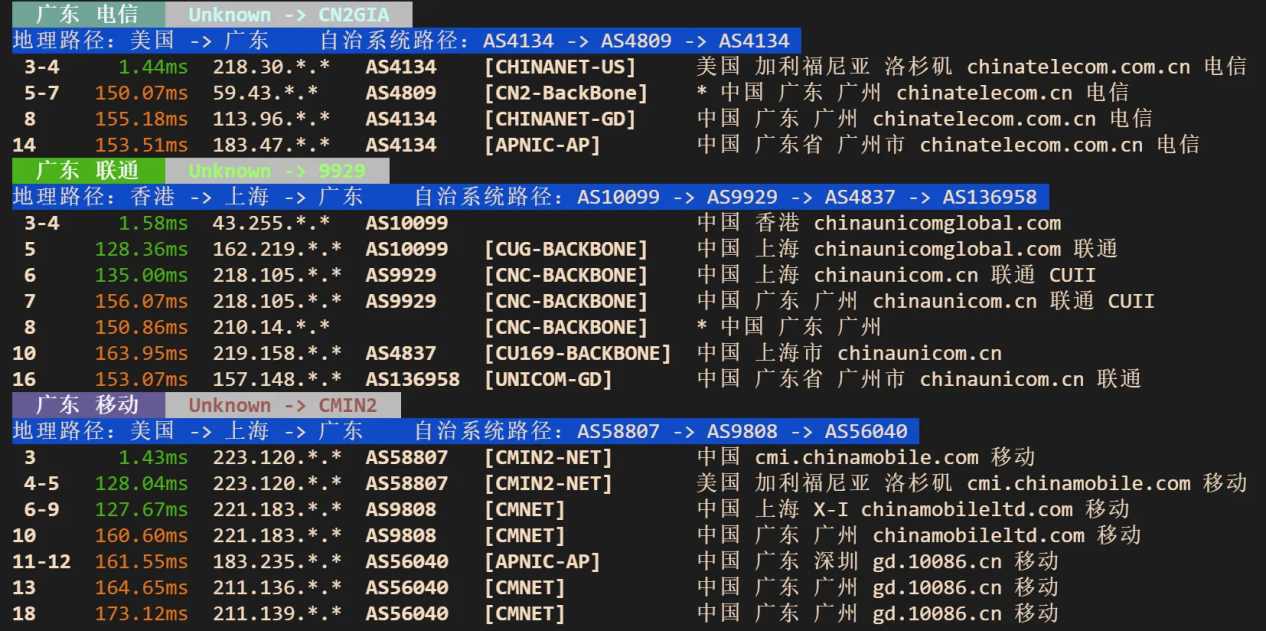
Using Guangdong Telecom as an example, the full route analysis yields the following conclusions:
Line Type | Return Characteristics | Primary Performance |
CN2 GIA | All three networks return via AS4809 nodes | Minimal hop count; ultra-low latency for nationwide access. |
AS9929 | Returns through the 9929 independent gateway | Significant boost in cross-carrier connectivity; minimal latency jitter. |
CMIN2 | Uses the dedicated CMIN2 outbound channel | Provides a "physical buff" for Mobile users by bypassing the crowded public backbone. |
Summary
In the network environment of 2026, there is no absolute "fastest," only the "most suitable." CN2 GIA wins on legacy and compatibility, AS9929 wins on low load and purity, and CMIN2 has leveraged its late-mover advantage to become the king for China Mobile users.
If you need a premium VPS that satisfies all three, consider the VMRack Three-Network Premium Series. It carries CN2 GIA + 9929 + CMIN2 simultaneously, ensuring your needs are met whether you are on Telecom, Unicom, or Mobile.
Technical Advice: Before deploying your business, it is recommended to use MTR to track routing trends for a continuous 24-hour period. Pay close attention to the response times of 59.43.x.x (CN2 GIA) or specific CMIN2 nodes during evening peak hours to select the stablest outbound route.


- Products
- VPS Hosting
- VPS HostingUnmetered
- Bare Metal
- GPU Rental
- CDNPublic Beta
- Custom CDN
- Object StoragePublic Beta
- TranscoderPublic Beta