Recommendations for reliable US native IP VPS!
When evaluating whether a US VPS is worth choosing, the first step isn't checking its specifications and price, but determining if its IP address is actually "native" to the US. Many so-called US native IP VPS recommendations actually use subleased, jump, or mixed address pool IPs, with routing that loops around inefficiently, degrading both speed and recognition accuracy. A genuine native IP is the true foundation for whether a VPS can be used stably.
What is a US Native IP
A US native IP means that three elements—its registration info (RIR records), actual physical location, and network routing—all genuinely point to local US network operators, rather than a "shared" address block purchased in bulk from upstream providers and resold by a regional ISP. This "three-way consistency" standard can be broken down: at the registration level, a WHOIS query shows the IP block registered under ARIN (the Regional Internet Registry for America and North America), belonging to a local US ISP or data center—rather than an address resold by foreign vendors with registration disconnected from actual usage; at the physical location level, IP geolocation databases (such as MaxMind) should match the actual location of the server's data center, rather than showing the US while physically relaying elsewhere; at the network routing level, data packets originating domestically should pass through official international gateways directly into the US backbone network, instead of detouring through transit nodes in other countries first.
The verification method is straightforward: use traceroute or mtr to inspect routing hops. A native IP’s route typically connects directly to the US domestic backbone network without looping through third-party countries or suffering abnormal latency spikes. You can also use IP lookup tools to verify whether the ASN and geographic information align; if there is a massive discrepancy between search results and actual access performance, it is almost certainly a subleased or spoofed IP. There are a few common "non-native" scenarios: first, the IP block itself is registered in the US, but the server is physically deployed in another region with artificially optimized routing; second, so-called "broadcast IPs" or "jump IPs", where traffic passes through transit servers before reaching the actual data center, sacrificing both latency and stability; third, shared or recycled proxy IP pools that get heavily flagged by risk management systems due to high-frequency usage across many accounts in a short time. Under these conditions, even if the promotion page claims "US IP," the actual user experience will fall far short of expectations.
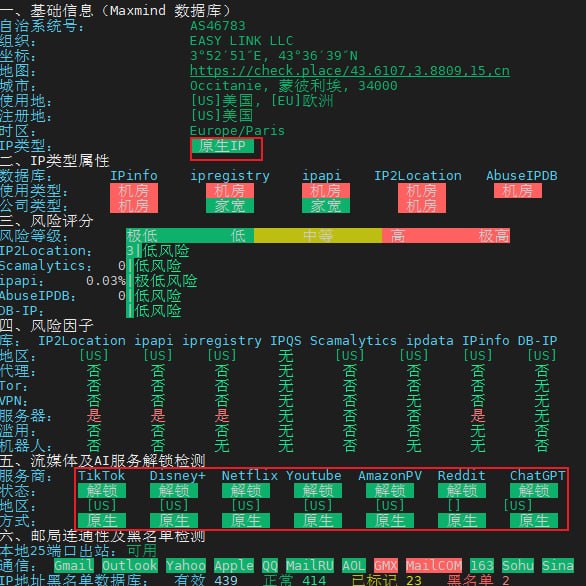
Where Do the Practical Benefits of a Native IP Show Up
The practical benefits of a US native IP mainly show up in two areas: recognition and access quality. Streaming platforms (Netflix, Hulu, etc.), search engines, and ad network systems perform risk management judgments based on real IP ownership, and native IPs have a significantly lower chance of being misidentified as proxies or restricted from access. At the same time, when accessing local US and surrounding regional resources, native IPs benefit from shorter routing paths and stable latency—which is crucial for web hosting SEO, cross-border payment API calls, and other scenarios. Testing latency and packet loss across multiple domestic and international nodes at different times using ping and mtr, focusing particularly on peak evening hour fluctuations, is the most direct way to verify whether this benefit truly exists.
Datacenter Architecture and Routes Determine Whether a VPS Can Run Stably
The IP solves the "identity" problem, while datacenter architecture and network routes solve the "stability" problem. VPS stability primarily depends on whether the datacenter possesses independent resource scheduling capabilities—if a provider doesn't operate its own datacenter and instead buys wholesale capacity upstream for resale, downstream users have virtually no leverage or priority protection when upstream lines fluctuate or run tight. In contrast, with self-hosted datacenter models like vmrack, providers maintain direct control over power, network, and hardware, resulting in shorter response paths during line adjustments or failures without needing multi-tiered communications.

Regarding route selection, mainstream solutions currently fall roughly into three categories: domestic-optimized premium routes for the three major networks, usually equipped with CN2 GIA, AS9929, and CMIN2 combinations, which keep peak evening latency well under control and suit high-real-time scenarios like remote desktops and live streaming; optimized three-network routes using 163, 10099, and CMI, offering higher cost-effectiveness for standard workloads without extreme latency demands; and international-facing native routes, such as Cogent or Arelion, which follow direct international interconnection paths without special return routing, making them best suited for sites targeting US or European users. Before choosing, figure out where your primary users are located and match the route accordingly—it is far more practical than blindly chasing top-tier specs.
Summary
Choosing a US VPS comes down to a simple core logic: first verify whether the IP is genuinely native, and then see if the datacenter and network routes can handle your actual business load. Using these two points as criteria for US native IP VPS recommendations will filter out most subpar products, helping you choose a server that is truly good to use and capable of long-term stability.


- Products
- VPS Hosting
- VPS HostingUnmetered
- Bare Metal
- GPU Rental
- CDNPublic Beta
- Custom CDN
- Object StoragePublic Beta
- TranscoderPublic Beta