VMRack premium VPS test across three networks
To verify the actual transit performance of the core network path, this article will conduct a rigorous VPS test (a professional method used to evaluate a server's overall network and hardware quality through route tracking, bandwidth benchmarking, and latency jitter testing) on the products of VMRack's self-built Los Angeles data center. The goal is to provide a reliable selection reference for technical teams with rigid requirements for mainland China access quality and machine performance, using real-world data on latency, streaming media unlocking, and physical data center protection.
Core Network Path Analysis
In this section, we will focus on the data center's underlying network architecture, exploring how premium bandwidth paths directly determine the access speed and user retention rates of cross-border businesses. Leveraging the advantages of its self-built data center in Los Angeles, VMRack has created a highly competitive premium three-carrier route. This network architecture perfectly integrates the top three return direct-connection combinations—China Telecom's CN2 GIA, China Unicom's AS9929, and China Mobile's CMIN2—specifically designed to solve cross-border network congestion between China and the US.
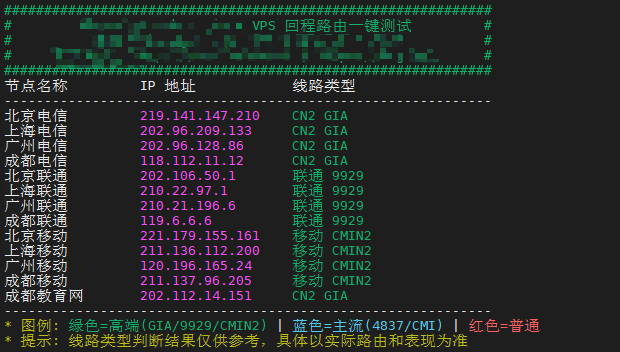
In actual testing, this premium three-carrier route demonstrated extremely high tolerance during peak hours. For China Telecom, traffic connects directly back to China via the premium CN2 GIA line (the high-end commercial channel of China Telecom's next-generation carrier network, featuring multiple premium nodes and dedicated bandwidth guarantees), completely bypassing the severe congestion of the regular 163 backbone network during evening peak hours. For China Unicom, the AS9929 golden path provides an exceptionally low jitter rate, ensuring stable packet transmission. For China Mobile, connection to the latest CMIN2 high-end network delivers a low-latency experience around the clock. This top-tier three-carrier return combination can keep the packet loss rate strictly under 1% during the peak evening network congestion "tsunami" from 20:00 to 23:00. Whether dealing with high-throughput cross-border e-commerce operations, or latency-sensitive remote desktop control and real-time audio/video streaming, this line provides rock-solid access quality, curing the chronic issue of laggy connections to overseas hosts.
Local Native IP Cleanliness and Streaming Unlocking Capability
Beyond network paths, overseas businesses have extremely strict requirements regarding the "lineage" and cleanliness of the underlying IP, as blacklisted IPs can directly trigger risk control mechanisms and lead to account bans. In our VPS testing of the VMRack Los Angeles data center, we specifically introduced authoritative third-party databases to conduct a multi-dimensional scan of the node's IP quality.
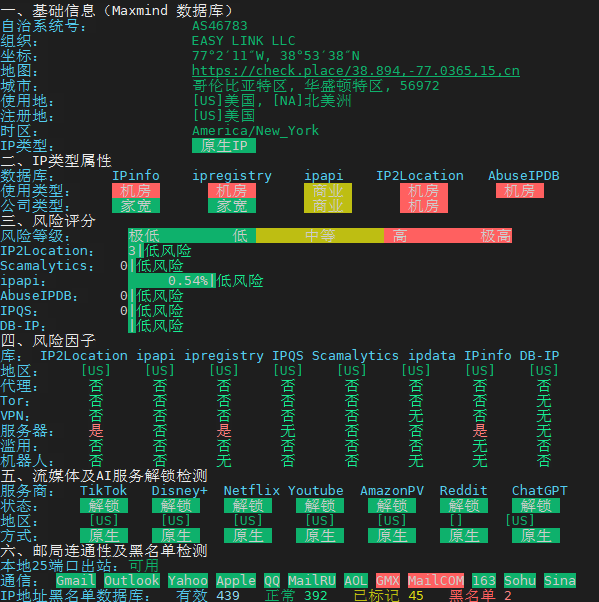
The test results indicate excellent quality for the US native IPs provided by VMRack. In Scamalytics fraud detection, the IP's Fraud Score was extremely low, falling into the unpolluted, high-quality clean residential/commercial bracket. This significantly reduces the risk-control ban probability for cross-border e-commerce merchants managing accounts and storefronts. Concurrently, in streaming media unlocking tests, the IP perfectly unlocked major platforms in the US region, including Netflix's Texas/Los Angeles native exclusive libraries, Disney+, Amazon Prime Video, and TikTok. This means overseas operations teams can use this server directly for localized matrix streaming marketing or build highly anonymous crawler relay nodes without purchasing expensive residential proxies, truly achieving a perfect balance between network transmission speed and IP business approval rates on a single node.
Self-Built Data Center Infrastructure and Los Angeles Tier 3+ Physical Architecture
For a server to stably support high-concurrency applications, besides having high-performance AMD processors providing continuous and stable computing output, the risk-resistance capacity of the underlying physical data center is the ultimate key to determining whether a business can operate uninterrupted. In this VPS test, we also conducted a comprehensive technical benchmarking of VMRack's backend data center environment and safety standards.
As a self-developed cloud infrastructure provider under EasyLink, VMRack relies on its powerful self-built Los Angeles data center, which complies with strict international environmental and energy management standards in its infrastructure construction. The data center is equipped with 2N redundant high-end UPS uninterruptible power supply systems and intelligent precision ventilation systems; even in the event of a sudden external power outage, power can switch seamlessly to ensure zero collapse in core hardware computing power. The facility also deploys Very Early Smoke Detection Apparatus (VESDA) and eco-friendly gas fire suppression systems, offering 24/7 all-around coverage. Furthermore, the data center enforces strict 7x24-hour access control with CCTV monitoring and has professional engineers on-site, allowing the intelligent monitoring system to sense any micro physical or network risks in real time and respond to incidents rapidly. This heavy-asset, self-built data center foundation not only perfectly handles complex virtualized computing tasks but also secures the user's core business infrastructure from the underlying physical defense line, delivering a smooth and secure experience comparable to dedicated servers.
Conclusion
In summary, through this comprehensive VPS test, it is clear that VMRack, leveraging its self-developed foundation in its self-built Los Angeles data center, has successfully created a US cloud infrastructure that combines powerful computing, clean IPs, and extreme network speeds. Its products not only exhibit remarkable stability and ultra-low latency during evening peak network congestion hours but also provide flawless underlying support for cross-border e-commerce, streaming matrices, and R&D teams through high-quality local native IPs and an international high-standard physical defense line. It stands as an ideal choice for commercial-grade overseas businesses that are sensitive to both latency and infrastructure quality.


- Products
- VPS Hosting
- VPS HostingUnmetered
- Bare Metal
- GPU Rental
- CDNPublic Beta
- Custom CDN
- Object StoragePublic Beta
- TranscoderPublic Beta