VMRack Triple-Network Platinum VPS Line Test
For overseas expansion businesses, cross-border e-commerce, and high-concurrency application developers, the biggest headache when choosing a US VPS is often not the server's CPU performance, but rather that public network path spanning across the Pacific. High network latency, severe packet loss during evening peak hours, and roundabout three-carrier return routing—these issues directly determine the end-user access experience. Today, we will conduct a comprehensive VPS route test on the VMRack Three-Carrier Optimized VPS (L2 Model). As a self-developed cloud infrastructure provider under EasyLink, VMRack relies on its self-built Los Angeles data center. Not only is its entire hardware line built upon high-performance AMD processors—optimized specifically for cloud virtualization environments to deliver continuous and stable computing power—but its network architecture has also received a massive upgrade. Next, we will use real-world data and route tracking to see what kind of surprises this cloud server, which rivals the smooth experience of a dedicated server, can deliver in terms of network connectivity.
How the Advantages of 10099 Break Evening Peak Network Congestion
For access originating from mainland China, the quality of the network path directly determines the life or death of foreign trade and overseas expansion businesses. VMRack’s Three-Carrier Optimized VPS (L2 product line) features an extremely luxurious configuration on its network path, utilizing the golden routing combination of 163 + 10099 + CMI. Among these, the advantage of China Unicom’s premium global network (10099) lies in its independent cross-border bandwidth resources separate from the standard 169 network. Even during late-night peak hours when international internet egress traffic explodes, it can leverage its relatively abundant backbone capacity to provide a high-bandwidth, low-packet-loss green channel for China Unicom users.
To perfectly support this top-tier network architecture, VMRack’s self-built Los Angeles data center strictly complies with rigorous international environmental and energy management standards, equipped with UPS uninterruptible power supplies, intelligent ventilation systems, and Very Early Warning Fire Detection. On this reliable foundation, where intelligent monitoring senses risks in real time and responds rapidly to incidents, this line maximizes its network advantages: China Mobile traffic connects directly back to China via high-bandwidth CMI, China Telecom is carried by the massive-capacity 163 backbone network, and China Unicom seamlessly taps into the premium 10099 route. This three-carrier collaborative optimization strategy fundamentally alleviates the industry pain point of bandwidth shrinkage and latency spikes during evening peak hours typically seen with traditional US West servers.
Real-World Multi-Regional Performance of Latency and Packet Loss Rate in Live Testing
Next, we used professional network testing tools to conduct live tests of Ping values and packet loss rates across multiple nodes for this VMRack Three-Carrier Optimized VPS deployed in the self-built Los Angeles data center. Within a professional data center environment backed by 24/7 access control monitoring and security personnel, the underlying high-performance AMD processors are providing powerful high-concurrency processing capabilities for the virtualized environment. Looking at the test results initiated from multiple core international egress cities in mainland China, including Guangzhou, Shanghai, and Beijing, the overall average latency stabilized between 130ms and 160ms. For a US West server crossing the Pacific, a response speed so close to the physical limit is nothing short of stunning.
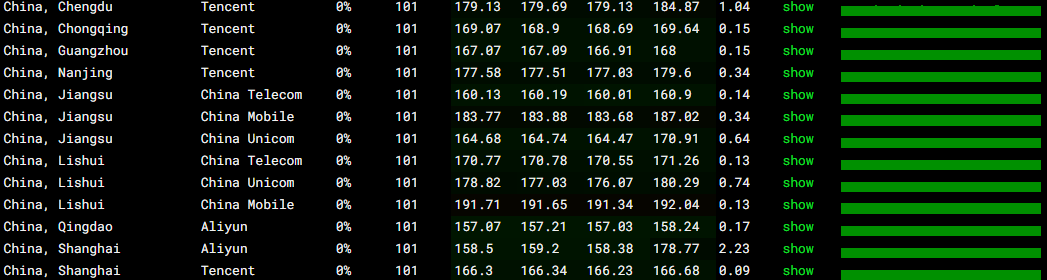
In terms of stability, we specifically selected the evening network peak hours from 20:00 to 23:00 to conduct a continuous 100-packet Ping test. At this most congested node of the public network, even the premium 10099 network cannot be completely immune to public network fluctuations. However, thanks to its ample cross-border capacity and the premium security guarantees of the self-built data center, the packet loss rate for the China Unicom line during the test period was still controlled at an extremely low level of around 1%, while the packet loss rates for the China Telecom and China Mobile lines also remained stably within an acceptable range of under 3%. This excellent dual performance of computing power and network offers an incredibly fluid experience without any sense of disconnection for users who require frequent API data interactions, remote desktop operations, or run cross-border e-commerce independent sites.
Three-Carrier Direct-Connection Return Route Tracking Without Roundabouts
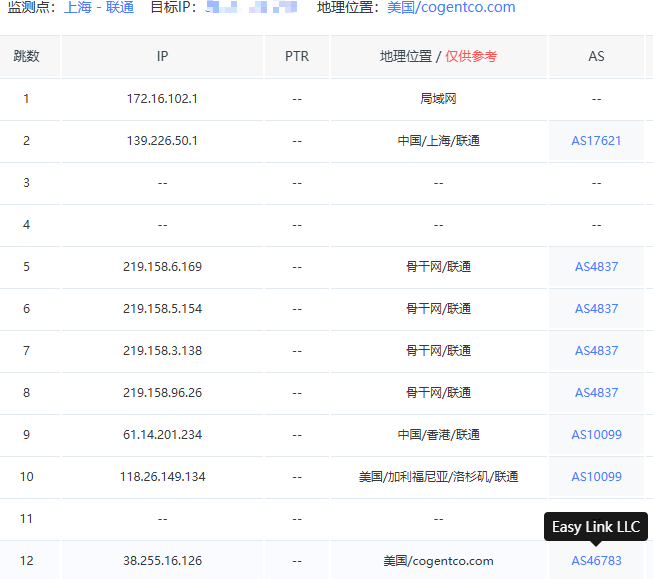
To verify whether VMRack has truly achieved three-carrier direct connection, we further used the MTR tool to perform return route tracking. The test results clearly show that after data packets leave the Los Angeles data center, China Mobile traffic immediately merges into AS58453 (CMI) to swim straight across the ocean back to domestic nodes; China Telecom connects directly to AS4134 (163 backbone network) locally in Los Angeles to reach major backbone nodes directly. The most eye-catching is the China Unicom return path: after leaving the facility, the data packets precisely enter the overseas nodes of AS10099, and then connect all the way without obstruction to the domestic China Unicom backbone, with absolutely no detours or routing through third-party countries mid-transit.
This "no-roundabout" clean routing not only reduces physical loss during network transmission but also drastically minimizes the risk of sudden network outages caused by intermediary transit node failures. We understand the diversity of businesses, which is why VMRack also shows great sincerity in its billing by offering two models: data usage billing and fixed bandwidth billing. You can choose the most cost-effective approach based on your business traffic model to achieve the optimal balance between cost and performance. Whether it is for sudden high-traffic CDN distribution and object storage businesses, or APP backends that pursue long-term low-latency bandwidth, users can obtain a high level of business flexibility with VMRack.
Conclusion
In conclusion, through this rigorous VPS route test, VMRack’s Los Angeles Three-Carrier Optimized VPS (L2) has demonstrated a remarkably high standard of network quality. Relying on EasyLink’s deep infrastructure heritage and the hardware assurance of its self-built data center, this product not only performs exceptionally well in terms of AMD high-performance computing power but also truly achieves high-speed direct connections for three-carrier users in mainland China through a scientific routing architecture. If you are looking for an overseas server that balances high computing output, high network stability, and flexible billing models, VMRack is undoubtedly a highly cost-effective option well worth deploying.
- Cost-Effective US Cloud Server Recommendation: Unveiling VMRack Los Angeles Node Performance
- Guide to Selecting US VPS Servers: The Advantages of Los Angeles Data Centers
- VMRack premium VPS test across three networks
- A compilation of affordable and reliable US CN2 VPS promotional plans for 2026
- What are the characteristics of CN2 GIA line VPS?


- Products
- VPS Hosting
- VPS HostingUnmetered
- Bare Metal
- GPU Rental
- CDNPublic Beta
- Custom CDN
- Object StoragePublic Beta
- TranscoderPublic Beta