Recommendation for High-Performance 9929 China Unicom Optimized VPS
When choosing a truly high-performance 9929 China Unicom optimized VPS, there is only one core criterion for evaluation: whether the latency and packet loss performance remains stable during evening peak hours. Even among US VPS servers, some access mainland China at lightning speeds while others suffer from severe lag and packet loss. The difference rarely lies in the data center location or hardware configuration; rather, it depends on which backbone network line is being used at the underlying layer. Many users are easily misled during purchase by vague marketing claims like "Unicom Optimized" or "BGP Multi-line," without understanding the specific technical meaning behind them. Today, from principle to practical operation, let's clarify what the 9929 line actually is and how to choose a genuinely stable product.
What Is the 9929 Line?
To understand what the 9929 line is, we must start with China Unicom's international outbound bandwidth. AS9929 is a high-end premium route operated by China Unicom, specifically designed to carry traffic extremely sensitive to latency and packet loss, such as remote desktops, real-time live streaming, and financial trading systems. Compared to China Unicom's standard international outbound routes, AS9929 features dedicated routing optimizations at the backbone level, allowing it to still maintain lower latency and lower packet loss rates during evening peak hours (typically 20:00–24:00 local time, the most congested period). Put simply, standard routes are like "everyone crammed on the same highway," while 9929 is an "express lane" carved out specifically for high-priority traffic.
From a technical implementation standpoint, China Unicom's standard international outbound routes carry a massive volume of commercial and entertainment data traffic. During evening peak hours or periods of tight cross-border bandwidth, latency and packet loss spike significantly. In contrast, AS9929 operates as an independently numbered Autonomous System, where China Unicom allocates separate international bandwidth resources and dedicated routing policies to avoid bandwidth competition with standard traffic. Real-world test data shows that during evening peak hours, standard routes may see latency jump from a normal ~180ms to over 300ms, with packet loss exceeding 5%. On lines optimized with 9929, however, latency can usually remain stable within 200ms, and packet loss is kept below 1%. While this difference might not be noticeable for basic web browsing, it represents the fundamental distinction between "usable" and "exceptional" for high-real-time requirements like remote desktops, video conferencing, and live streaming.
For this reason, an increasing number of webmasters and enterprises targeting mainland users now explicitly require data centers to provide AS9929 line support when selecting overseas servers, rather than vaguely choosing so-called "Unicom Optimization," since the degree and scope of the latter often lack unified standards and yield inconsistent results.
Differences Among the Premium Lines of China's Big Three Carriers
Having understood 9929, it is necessary to examine the differences among the premium lines of the big three carriers (Telecom, Unicom, and Mobile). Their backbone network architectures differ, and each has its own designation for premium routes, which many users tend to confuse. China Telecom's premium line is CN2 GIA, currently recognized as having the lowest latency and best stability among Telecom routes. It uses a backbone architecture independent of standard CN2, is widely applied in gaming acceleration and cross-border e-commerce, and is the most famous among all three carriers' premium routes. China Unicom's equivalent is the aforementioned AS9929, which primarily covers the international access needs of Unicom users. China Mobile's premium route is CMIN2, specifically optimized for Mobile users' international outbound traffic to make up for the higher latency experienced on traditional routes when accessing overseas servers.
Although these three lines belong to different carriers, their design philosophy is identical: utilizing independent routing resources and dedicated bandwidth to avoid mixing with standard commercial traffic, thereby guaranteeing network quality during peak evening hours. However, it should be noted that the costs of all three premium routes are generally higher than standard routes because carriers assign scarce, high-quality bandwidth resources to them. Consequently, many products on the market labeled as "Premium Lines" may actually implement only one or two of them, or even impersonate premium routes using standard optimized lines. Users should pay extra attention to this when purchasing and ideally request specific route testing or MTR trace results from the provider to verify.
If a server features CN2 GIA, AS9929, and CMIN2 all at once, it is typically referred to as "Triple-Carrier Premium" or "Triple-Carrier Optimized." Products of this caliber deliver superior access experiences for China Telecom, China Unicom, and China Mobile users alike. Their performance in stability and latency significantly surpasses lines with only standard optimizations, making them particularly suitable for national audiences and business scenarios with stringent network quality demands.
VMRack Premium Lines
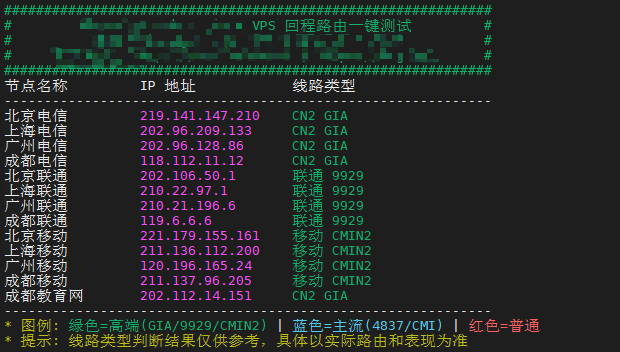
At the practical product level, VMRack Premium Lines serve as a typical representative of such Triple-Carrier Premium solutions. Leveraging its self-built Los Angeles data center, VMRack offers its Triple-Carrier Premium VPS (L3 product line), equipped simultaneously with CN2 GIA, AS9929, and CMIN2 top-tier routes. Covering users across Telecom, Unicom, and Mobile, its core selling points are evening peak stability and low latency, making it ideal for network-demanding business scenarios like remote desktop usage and real-time streaming. Because the data center is fully self-built and in-house managed, VMRack can execute finer scheduling and monitoring over network resources. Combined with over 200Gbps of free DDoS protection capacity, it ensures the network line remains unaffected even during sudden attacks. Beyond Triple-Carrier Premium, VMRack also offers multi-tier routing plans including Triple-Carrier Optimized VPS (L2, equipped with 163 + 10099 + CMI) and US Native BGP (L1, featuring Cogent and Arelion), allowing flexible selection based on budget and business needs.
Summary
Overall, choosing a suitable 9929 China Unicom optimized VPS hinges on understanding the technical logic behind the network routes rather than relying solely on promotional slogans. Only servers genuinely equipped with independent premium routing and validated through actual evening peak testing can deliver a truly stable, low-latency access experience for mainland China users.


- Products
- VPS Hosting
- VPS HostingUnmetered
- Bare Metal
- GPU Rental
- CDNPublic Beta
- Custom CDN
- Object StoragePublic Beta
- TranscoderPublic Beta