How is the CMIN2 line?
If you are shopping for a US VPS or cloud server, you will most likely see the term "CMIN2" in the configuration descriptions. How is the CMIN2 route, and is it worth spending a bit more budget on it? This is the question that many webmasters and enterprise users care about the most when selecting a model. To answer this question, we must first figure out its technical principles, actual performance, and the gap between it and other routes.
What is the CMIN2 Route
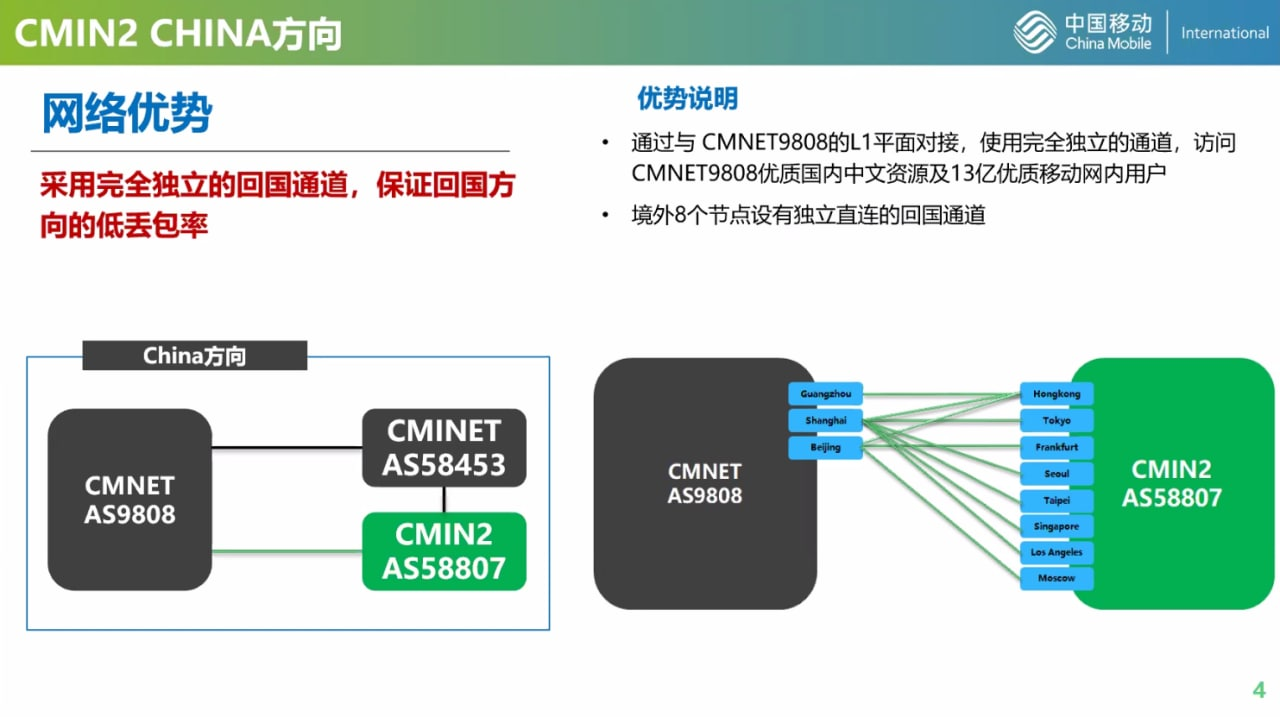
What on earth is the CMIN2 route? CMIN2 stands for China Mobile International Network 2.0, which is a new generation of high-quality direct routing introduced by China Mobile International. Unlike traditional international gateways that relied on third-party backbone network transit in the early days, CMIN2 adopts a more optimized technical architecture, achieving minimized transit hops for data packets during cross-border transmission through self-built or deeply cooperated international dedicated lines.
Data packets on ordinary international routes may need to go through multiple operator nodes before reaching their destination, and each hop will bring delay accumulation and packet loss risks. The design goal of CMIN2 is to let China Mainland mobile users access overseas servers through a relatively "exclusive" and optimized path, thereby reducing latency and congestion from the source. From the actual user experience, the latency of CMIN2 during normal hours can usually be controlled at a low level, especially during evening peak hours when many ordinary routes experience sudden latency surges and rising packet loss rates. Relying on its high-quality link resource guarantees, CMIN2 has relatively smaller fluctuation amplitudes, which is particularly important for latency-sensitive businesses such as remote desktop office work and real-time audio and video streaming.
From the perspective of technical implementation, the core reason why CMIN2 can maintain stable transmission quality lies in its exclusive scheduling of international export bandwidth. Traditional transit links usually share the same batch of backbone network resources among multiple operators, which makes them prone to queuing and congestion once traffic surges, specifically manifested as rising packet loss rates and slow loading. In contrast, the bandwidth of CMIN2 is relatively independent and will not be significantly interfered with by peak access from other operators. Its path is also more fixed, making it easy to accurately estimate performance, which is particularly critical for the stability assurance of enterprise-grade applications.
The Difference Between CMIN2 and CMI
Many users easily confuse CMIN2 with CMI, but the two actually have essential differences. CMI (China Mobile International) is an earlier international export route of China Mobile, belonging to traditional optimized networks. Although it has undergone a certain degree of routing optimization, its overall architecture still relies on multi-node transit, making it prone to congestion during peak hours with relatively large latency fluctuations.
CMIN2, on the other hand, is a high-quality direct connection solution upgraded by China Mobile on the basis of CMI, which can be understood as the relationship between a "boutique version" and a "standard version". The difference between CMIN2 and CMI is mainly reflected in link grades and resource guarantees: CMIN2 enjoys higher-priority bandwidth scheduling and fewer transit nodes, so it is superior to CMI in core indicators such as latency, packet loss rate, and peak stability. If your business has high requirements for access quality, such as corporate official websites, cross-border e-commerce, and real-time communication applications, choosing a route equipped with CMIN2 will bring a more obvious experience improvement than ordinary CMI routes. If it is only lightweight static content access, CMI can also meet basic needs with greater cost advantages.
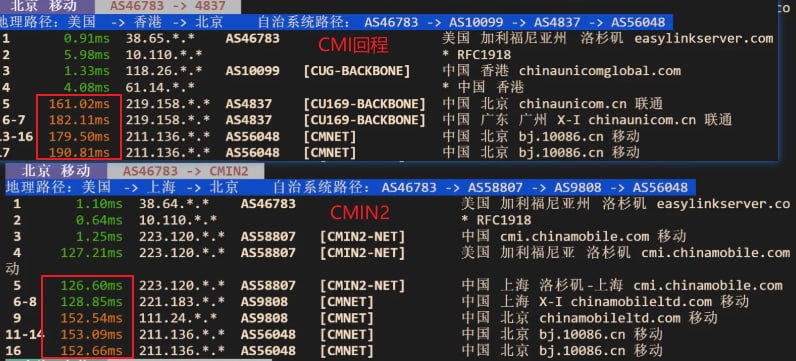
Looking closely at the differences between the two, they are mainly reflected in three levels: the number of nodes, bandwidth priority, and packet loss performance. CMI usually needs to pass through several transit nodes to reach the target server room, and each added hop means an extra layer of latency accumulation. CMIN2 significantly streamlines the transit links and is closer to a direct connection method. At the same time, CMIN2 has higher scheduling priority. Even if the overall network load is high, it can still prioritize transmission quality and maintain the packet loss rate in a low and stable range, which is particularly important for businesses with high real-time requirements.
VMRack High-Quality Route
For users who want to obtain the ultimate three-network access experience, a single route is often not enough, which is also the original design intention of the VMRack high-quality route solution. Relying on its self-built server room in Los Angeles, VMRack simultaneously equips its three-network high-quality VPS products with three top-tier routes: Telecom CN2 GIA, Unicom AS9929, and Mobile CMIN2, which respectively correspond to the optimal exits of the three major operators. This achieves "three networks complete, each taking its own high-quality channel", avoiding the overall experience decline caused by the pressure on a single route.
This combination scheme is particularly suitable for business scenarios with rigid requirements for mainland access quality, such as remote desktop office work, real-time streaming, and online transaction systems. Relying on the complete independent resource control right of the self-built server room, coupled with free defense capabilities exceeding 200Gbps, VMRack can provide users with stable and reliable underlying infrastructure support while ensuring route quality.
Summary
Taken together, the answer to the question of how the CMIN2 route performs is relatively clear: as a high-quality route of China Mobile, it is significantly superior to traditional international routes in terms of latency, stability, and peak experience by virtue of fewer transit nodes and higher bandwidth guarantees, making it particularly suitable for business scenarios with high requirements for access quality. When purchasing a VPS or cloud server, understanding the technical underlying logic of the route can help users more accurately match their own business needs and avoid actual user experience issues caused by poor route quality.

- Products
- VPS Hosting
- VPS HostingUnmetered
- Bare Metal
- GPU Rental
- CDNPublic Beta
- Custom CDN
- Object StoragePublic Beta
- TranscoderPublic Beta