How Does a Bare Metal Server Handle High-Load Workloads?
E-commerce flash sales, game server launches, video transcoding, big data processing — these business scenarios share a common trait: sudden spikes in concurrency and heavy resource consumption. Ordinary shared cloud instances can easily stutter or even go down at critical moments. The root of this problem usually lies in resource contention at the virtualization layer: multiple tenants share the same physical hardware, so when one tenant's load spikes, the performance of the others is indirectly dragged down. For these scenarios, the best solution is Bare Metal.

Bare Metal has a wide range of use cases. For high-load workloads in particular, Bare Metal resources — with dedicated hardware and no virtualization overhead — deliver more stable, more predictable performance, making them a more reliable choice for high-concurrency, high-throughput business. The following sections cover how to handle high-load pressure from three angles: hardware and network architecture, security and stability safeguards, and elastic scaling with automated operations.
1. Planning Hardware Configuration and Network Architecture Wisely
Handling high-load business starts with leaving enough headroom in hardware specifications. CPU and memory are the resources that hit bottlenecks first; it's best to provision 1.5 to 2 times the peak business load rather than sizing for daily averages. Otherwise, when sudden traffic spikes hit — during flash sales or game launches — performance bottlenecks appear immediately, hurting response times and user experience.
For storage, prioritize NVMe SSDs as system and data disks. Their random read/write latency is far lower than traditional SATA SSDs or mechanical drives, which significantly eases I/O-heavy pressure such as high-concurrency database queries and log writes.
Take VMRack's Bare Metal Server as an example: the entire lineup uses high-performance processors, achieving 100% physical isolation so CPU and memory resources are fully dedicated, with no performance loss from a virtualization layer. This kind of hardware architecture is especially well-suited to demanding tasks such as large databases, high-performance computing, and high-frequency trading.
Common business types and their hardware resource priorities are summarized in the table below:
Business Type | Resource Priority | Configuration Recommendation |
E-commerce flash sales / high-concurrency web | Multi-core CPU + large bandwidth | High-frequency multi-core CPU, reserve 50%+ bandwidth headroom |
Database / big data computing | Memory + NVMe storage | Large memory capacity, NVMe SSD as data disk |
Video transcoding / rendering | CPU compute power + stable bandwidth | Multi-core high-performance CPU, capable of stable long-term operation |
Game server launches / real-time interaction | Low-latency network | Prioritize low-latency routes, reserve burst bandwidth for launch-day peaks |
User-experience issues caused by high-concurrency access are often not due to insufficient server performance but to substandard network egress quality. Whether bandwidth is easily saturated, whether cross-carrier access takes a roundabout route, or whether packet loss occurs during peak evening hours — all of these directly affect users' actual access speed.
2. Security Protection and Stability Safeguards
Once a high-load business encounters a DDoS attack or abnormal traffic surge, already-strained resources can be exhausted in an instant, making the service unavailable. So beyond capacity planning, security protection capabilities also need to be considered before going live, rather than being patched together after problems occur.
When choosing a Dedicated Server, it's worth confirming in advance whether the data center offers traffic scrubbing, IP broadcasting, and other protective measures, and whether abnormal traffic can be quickly diverted when an attack occurs so normal business traffic stays unaffected. At the same time, having dedicated hardware resources also means not being affected by the load fluctuations of other tenants in the same facility — which matters a great deal for scenarios such as financial transactions and real-time gaming that demand high stability.
At the network architecture level, the following approaches can further improve business stability and security boundaries:
• Multiple IPv4 allocation: distribute traffic from different business modules or clients across different IPs, reducing the impact if a single IP is blocked or attacked;
• Internal (private IP) connectivity: communicate within the same data center over a private network, reducing public bandwidth usage and lowering the risk of data interception;
• Multi-route redundancy: configure multiple outbound routes for core business, allowing a quick switch if one route fails, avoiding single points of failure;
• Access control: combine firewall rules and port policies to limit unnecessary external exposure and shrink the potential attack surface.
Combining these measures provides a more complete security defense for high-load scenarios, rather than relying on hardware performance alone.
3. Elastic Scaling and Automated Operations
Business load is never static. If resource configuration still sits at peak-period levels after a flash sale or event ends, it causes noticeable cost waste. So when handling high-load business, it's also important to consider how easily resources can be scaled up or reclaimed — whether quick upgrades, on-demand bandwidth switching, and other flexible adjustments are supported.
Beyond scaling capability itself, ongoing monitoring and capacity planning are equally indispensable. It's worth establishing an always-on resource monitoring mechanism that tracks the following key indicators:
• CPU and memory utilization trends, to judge whether capacity limits are being approached;
• Peak network bandwidth usage, to assess whether a higher bandwidth tier is needed;
• Disk I/O and read/write latency, to catch storage performance bottlenecks early;
• Cyclical patterns in historical peak data, to inform the next round of capacity adjustments.
Using monitoring data to anticipate capacity bottlenecks ahead of time — rather than troubleshooting only after the business already stutters — makes the entire operations process more proactive, more controllable, and provides data to support future resource planning.
VMRack's Bare Metal Server provides full root administrative access, letting users freely configure the server environment and operating system, with support for remote reboot, OS reinstallation, and other operations, making deployment and day-to-day management easy. Paired with a fully automated technical architecture, configuration changes, OS reinstalls, bandwidth adjustments, and other operations can all be completed quickly in the backend, cutting down the delay caused by manual intervention — especially useful for business scenarios that need to scale resources frequently.
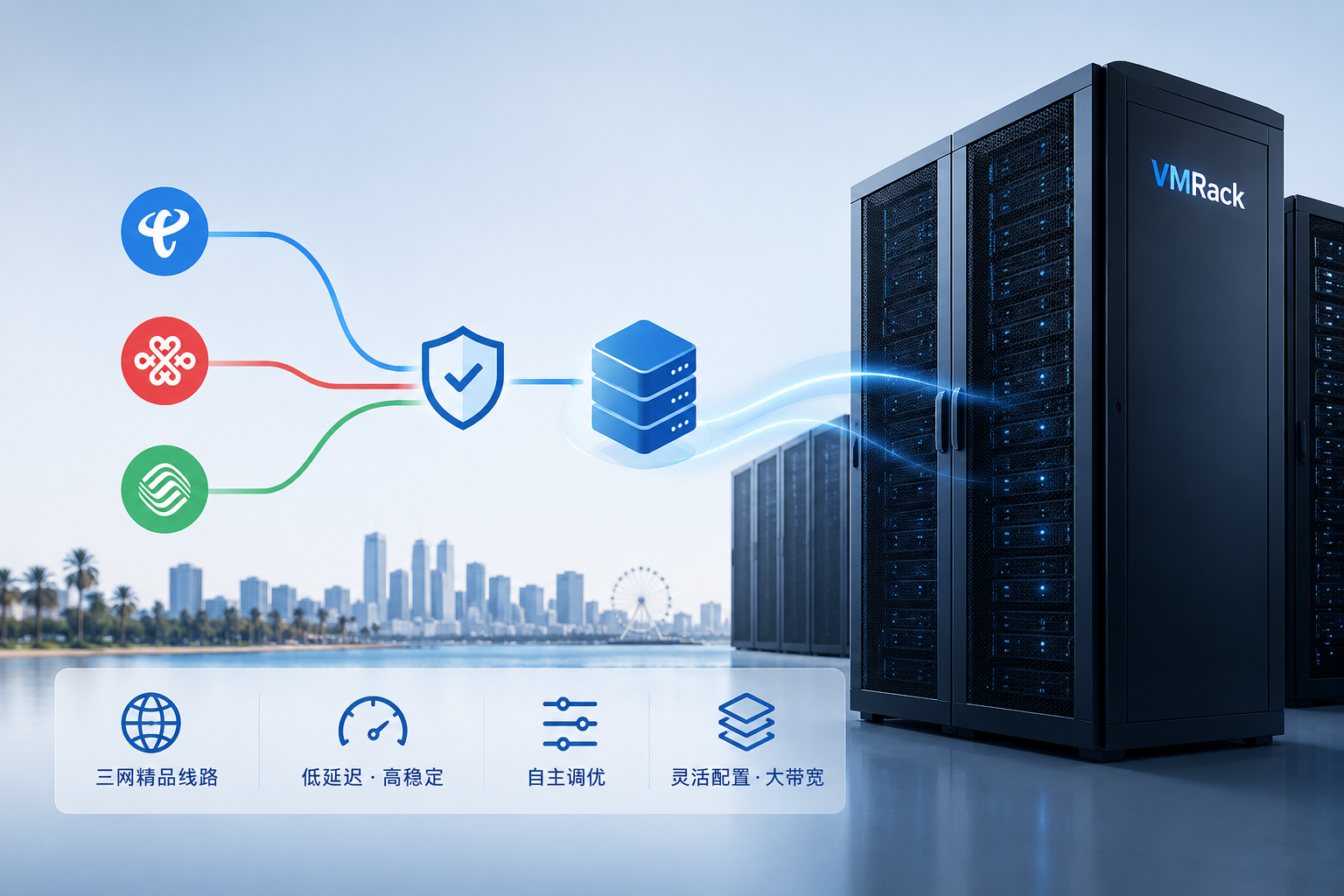
VMRack draws on high-quality bandwidth resources at its data center, integrating premium tri-network routes (CN2 GIA + 9929 + CMIN2) along with optimized tri-network routes, and connecting with tier-1 global carriers such as Cogent and Arelion. This keeps response latency low even in high-frequency access scenarios such as game acceleration and cross-border e-commerce, helping safeguard the user experience for high-load businesses.
It also supports mainstream systems including CentOS, Rocky, Ubuntu, Debian, and Windows, making it easy to migrate different types of business directly and reducing the extra cost of environment adaptation.
Summary
Overall, handling high-load business requires considering multiple dimensions together — hardware and network architecture, security and stability safeguards, and elastic scaling with automated operations. Bare Metal resources, with their dedicated performance and flexible customization, are precisely what provide a more stable underlying foundation for these scenarios.
- Is MySQL Suitable for Deployment on a Bare Metal Server?
- What Are the Common Use Cases for Bare Metal Servers?
- Recommended US-based unlimited traffic VPS!
- Recommended High-Performance VPS CN2 Servers and GIA Line Identification Guide
- GIA CN2 VPS Server Basic Environment Configuration and System Acceleration Tutorial

- Products
- VPS Hosting
- VPS HostingUnmetered
- Bare Metal
- GPU Rental
- CDNPublic Beta
- Custom CDN
- Object StoragePublic Beta
- TranscoderPublic Beta